University of California, Riverside
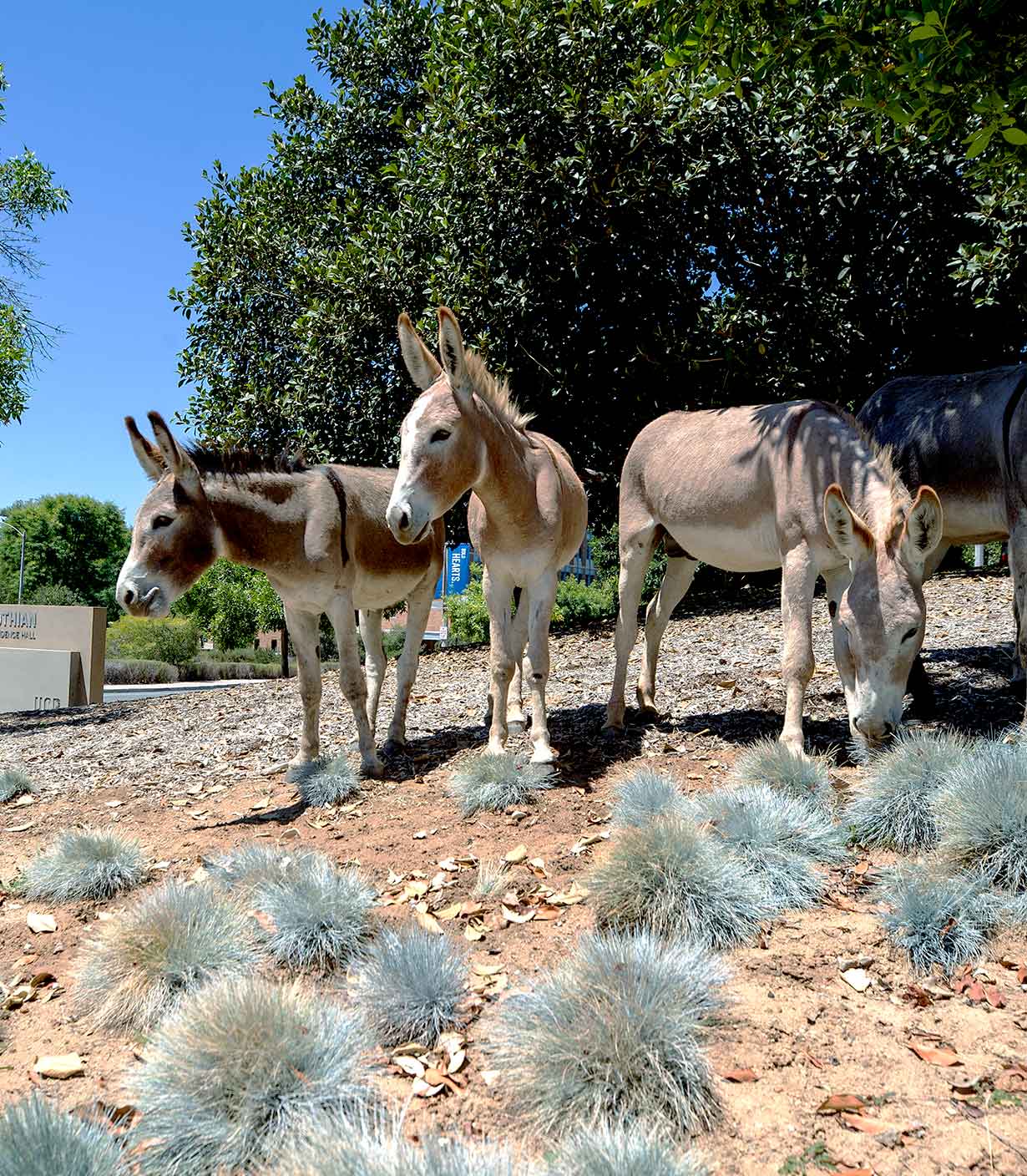

They weigh 500 pounds, love manicured lawns, and spark fierce local debate. The Inland Empire’s wild burros are beloved icons to some and public safety hazards to others. Yet surprisingly little is known about them. Now, UC Riverside ecologists are launching a study using DNA analysis and wildlife cameras to trace the herd’s history, estimate its population, and provide the data needed to help humans and burros safely coexist.
At roughly 500 pounds apiece, these honorary members of the UC Riverside community pretty much go wherever they want, paying little mind to where they leave their droppings.
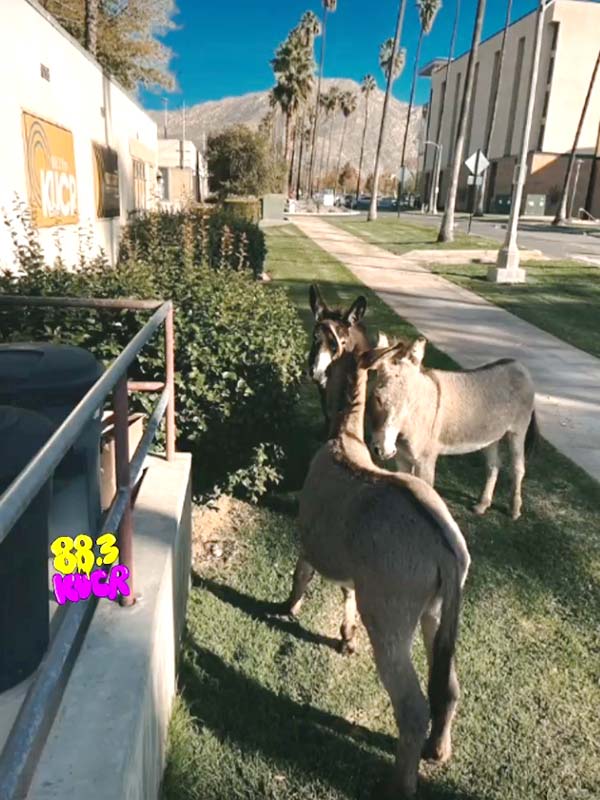
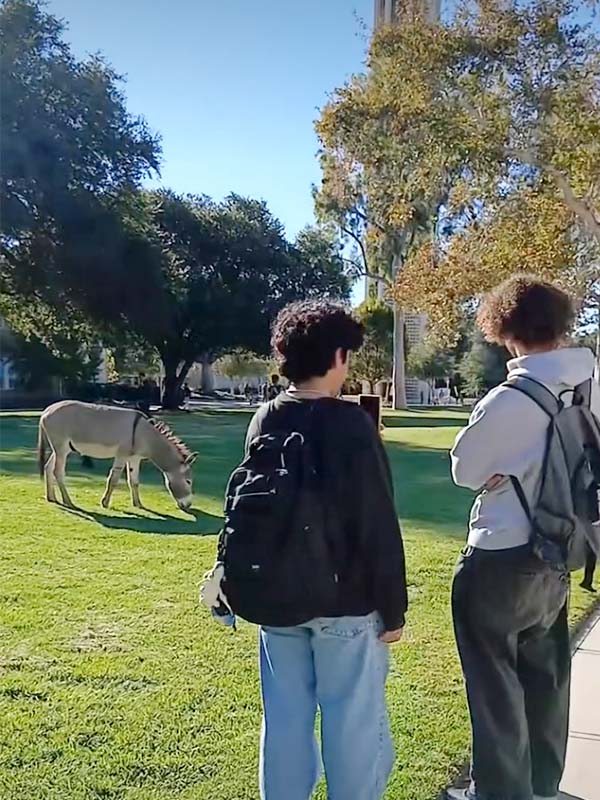
Beloved by many at the university, they are the Inland Empire’s wild burros — a free-ranging population of donkeys that has long inhabited the hills of the Box Springs Mountain Reserve near UCR. While they have been seen around campus for years, the burros have recently been making more frequent visits to campus to graze on well-irrigated lawns and landscaping.
Their range extends well beyond campus east and north of UCR into the hills, canyons, and badlands that straddle the Riverside-San Bernardino county line, including parts of Riverside, Moreno Valley, Colton, Loma Linda, and Redlands.
A well-known presence throughout the region, the burros frequently make headlines and inspire strong — and often conflicting — opinions. Depending on whom you ask, they are invasive, a nuisance, dangerous, intelligent, adorable, or simply an iconic part of the Inland Empire landscape. Yet surprisingly little is known about them.
Marko Spasojevic, a community ecologist at UCR, hopes to change that. An associate professor in the Department of Evolution, Ecology, and Organismal Biology, Spasojevic has launched a research project to determine precisely where the wild burros live, estimate their population size, assess whether their numbers are growing, examine their effect on the landscape, and trace their origins.
Beyond learning more about the animals themselves, the findings could help land managers and local governments develop more effective and humane strategies for managing the growing interactions between people and burros.

A Colorful History
A Colorful History
One of the biggest mysteries surrounding the animals is where they actually came from.
Some believe ranchers brought the burros from Death Valley during the 1950s, after they were no longer needed for mining. Others think they escaped from ranches over the years or were abandoned by miners when their luck ran out. Yet first-hand accounts of such origins remain elusive.
To help answer that question, Spasojevic is collaborating with UCR evolutionary biologists Ellie Armstrong and Kieran Samuk to analyze DNA collected from deceased burros provided by county officials. By comparing the animals’ genetic profiles with those of burro populations elsewhere, the researchers hope to identify the Inland Empire population’s closest relatives and reconstruct where they originated.
“People have sequenced donkey genetic information in other places,” Spasojevic said. “So, if we have genetic data on burros from other locations, then we can compare the genetics of these donkeys to other populations and see which ones they’re most closely related to.”
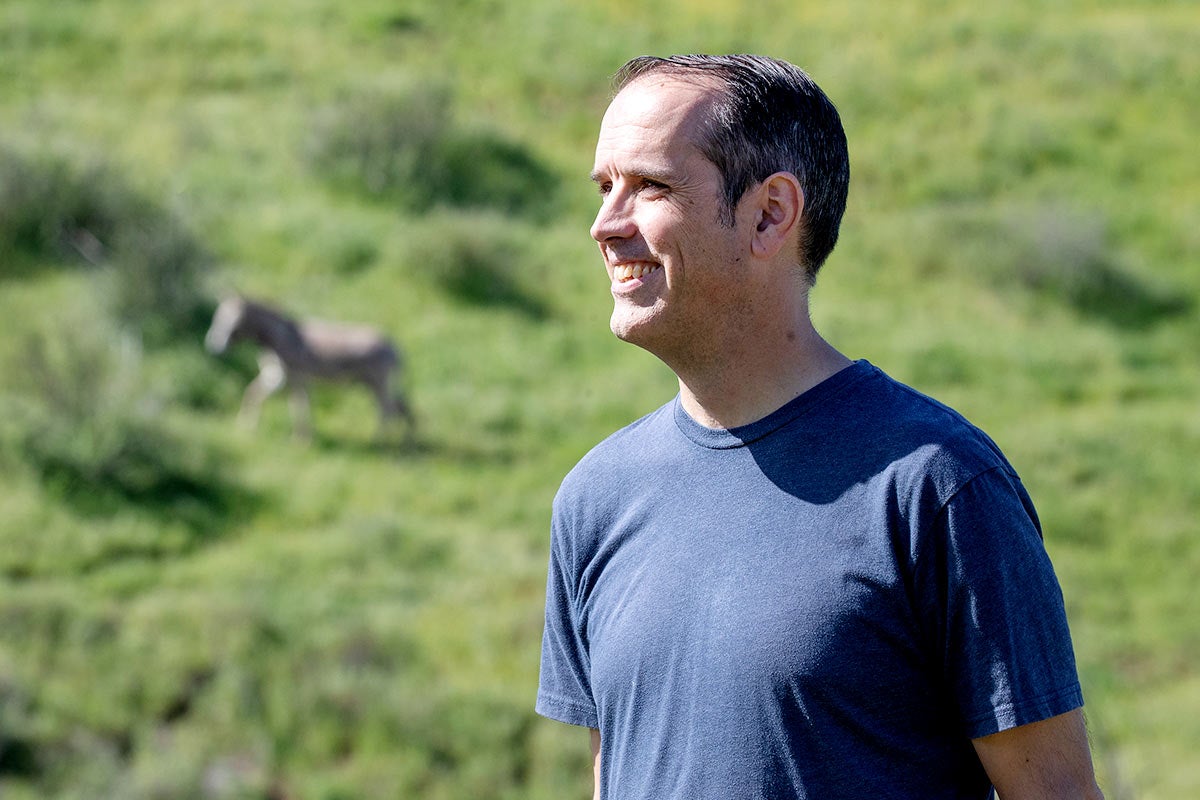
UCR community ecologist Marko Spasojevic in the Box Springs Mountain Reserve, home to the wild burro herds he studies.
The search could trace the animals’ history back hundreds of years.
Burros are descendants of African wild asses, which were domesticated in northeastern Africa between 5,000 and 7,000 years ago as pack and riding animals because of their strength, sure-footedness, and calm temperament.
The animals reached Spain during the Roman Empire and, by the 1500s, Spanish colonists were transporting them, along with horses, cattle, and other livestock, to New Spain — present-day Mexico. It was geopolitical rivalry between Spain and other European powers that may have brought the first burros to the Inland Empire.
By the early 1770s, Spain was moving to secure Alta California, the vast colonial province that encompassed present-day California and much of the American Southwest. To strengthen its claim before rival nations could establish footholds, Spain decided to establish a military and civilian settlement at San Francisco Bay.
To reach the bay, Spanish officials recruited settlers from the Sonora province, in present-day Mexico south of Arizona, and commissioned military captain Juan Bautista de Anza to establish an overland route from north central Mexico to the recently founded Mission San Gabriel.
De Anza’s first expedition in 1774 included 31 soldiers and what he described in his diary as 140 “saddle animals,” most likely horses, donkeys, and mules. Traveling north from Sonora, the expedition crossed present-day Arizona, passed through what is now Anza-Borrego Desert State Park, entered western Riverside County through a mountain pass, and continued through present-day Hemet, San Jacinto, and Moreno Valley before crossing the Santa Ana River in what is now Riverside. Based on these accounts, burros most likely passed through the Inland Empire in March 1774.
De Anza’s party then continued to Mission San Gabriel before following established routes north to San Francisco Bay, completing the overland route — known as the Anza Trail — that opened Alta California to permanent Spanish settlement.
In 1775, the Spanish monarchy financed a second, much larger expedition led by de Anza that included 240 settlers, many of them families recruited from impoverished communities in the Mexican states of Sonora, Chihuahua, and Sinaloa. This time, the expedition brought hundreds of livestock.
The Anza Expedition
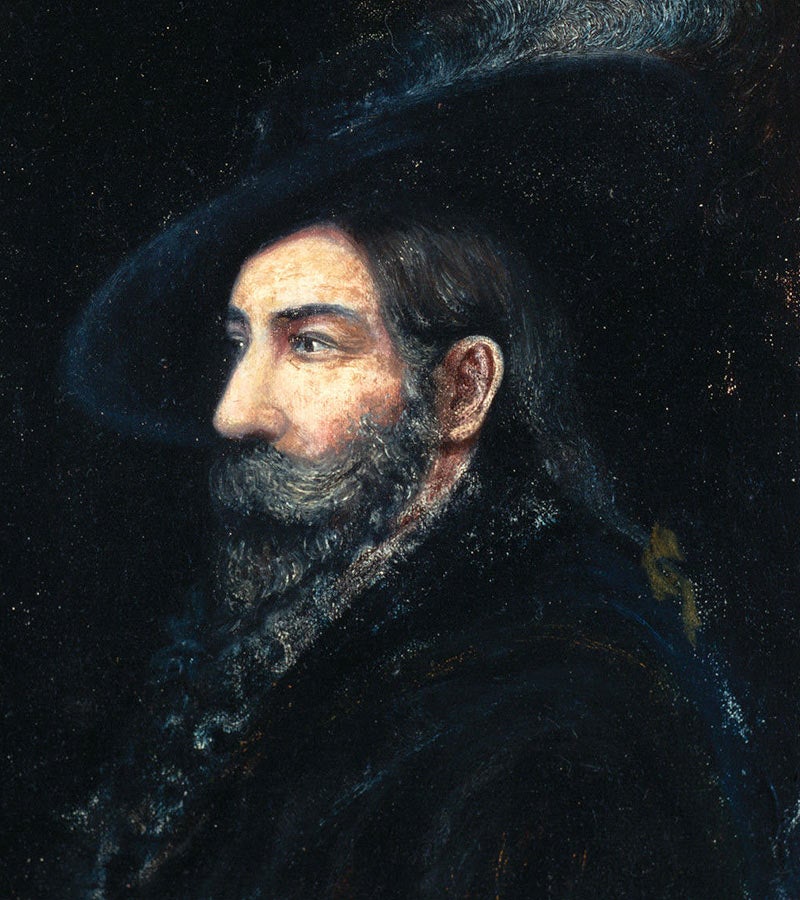
Between 1775 and 1776, de Anza led 240 settlers and hundreds of livestock on an expedition from present-day Sonora, Mexico, to what was then known by the Spanish as Alta California.
Portrait of Juan Bautista de Anza (Fray Orci, 1774, University of New Mexico, Digital Collections)

The original route of de Anza’s 1775-1776 expedition. The blue star marks the location of present-day Riverside.
At a staging camp near what is now Tubac, Arizona, one of the expedition’s priests, Father Pedro Font, recorded in his diary that the party included “burros.” Specifically, he listed 695 horses and mules, 325 cattle, and “some thirty mares, colts, and burros.”
The expedition crossed the Santa Ana River in present-day Riverside in January 1776 before continuing to San Francisco Bay.
Wild burros have long inhabited the hills of the Box Springs Mountain Reserve near UCR.
The journeys succeeded in large part because of the Quechan, or Yuma, people. Their leader, Salvador Palma, welcomed the expedition, helped the travelers safely cross the Colorado River, and provided guides, food, livestock support, and protection — resources historians say were essential to opening the overland route to California.
No one can say whether any of the expeditions’ burros escaped and established feral populations in the Inland Empire, or whether they were the first of their species to set hoof here — but the possibility remains.
The influx of people and livestock into California was pivotal. Three hundred more settlers traveled the Anza Trail during the next five years, and the domestic cattle and horses provided “the initial stock for the expanding herds of Northern California,” historian Peter L. Gough wrote in a 2012 report for the National Park Service.
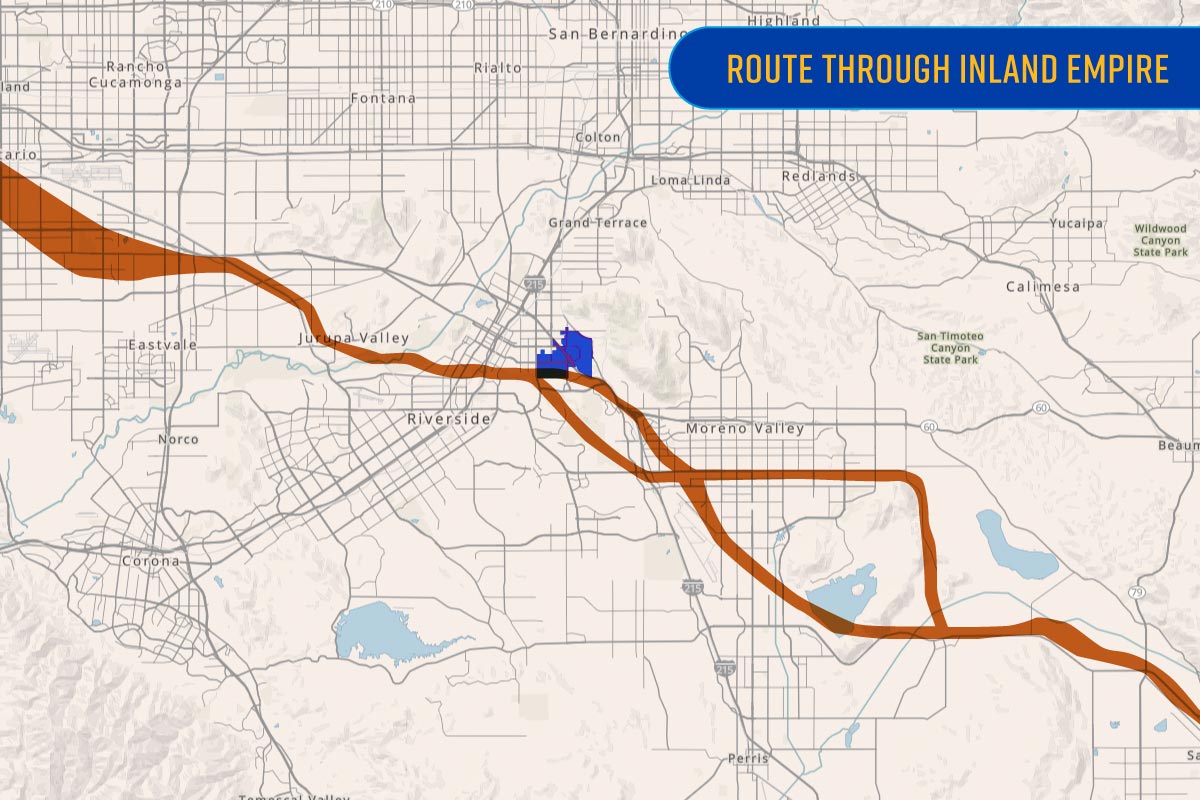
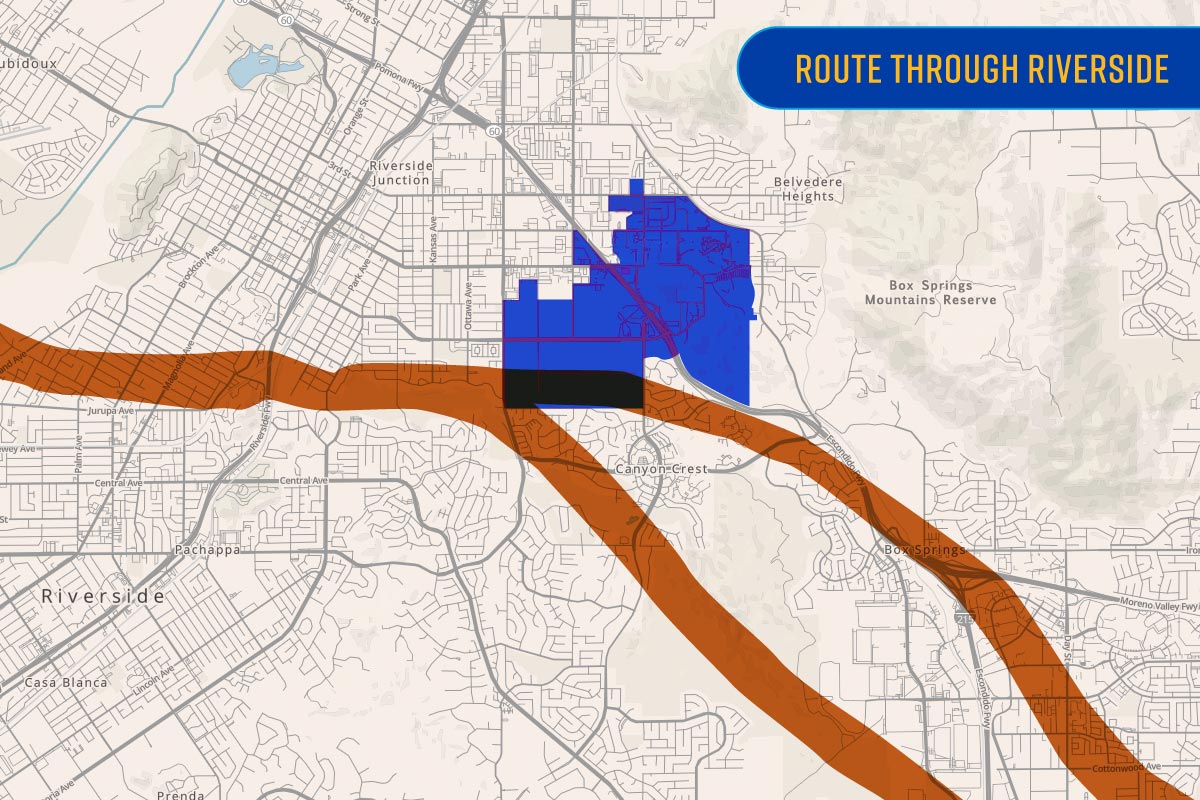
A closeup of the Anza Trail through the Inland Empire and Riverside (Based on an interactive map by the National Park Service, adapted by UCR)
The Road to Riverside
Spanning 1,200 miles from Arizona to Northern California, the Anza Trail passes through the heart of the Inland Empire. The section shown highlights the route between San Jacinto and Ontario, including a stretch through Riverside that runs directly next to the UCR campus.
Map Legend
By the late 1800s, burros had become an ordinary part of life across the Inland Empire and surrounding mountains.
Newspaper accounts described burros hauling camping gear into the San Bernardino Mountains, packing ice over rugged trails, and commanding premium prices during Baja California’s gold boom — evidence that the sure-footed animals had become indispensable to construction, transportation, mining, and commerce throughout Southern California.
Tracking the Burro Boom
Tracking the Burro Boom
Beyond their origins, even the size of the Inland Empire’s wild burro population remains uncertain.
Estimates reported in news stories, government documents, and public statements range from several hundred animals to more than 10,000. Through this project, Spasojevic hopes to produce the first scientifically rigorous population estimate.
Beginning this fall, graduate student Wyatt Hall will deploy 40 to 50 motion-activated wildlife cameras across the burros’ range, using electric mountain bikes to reach remote locations. The researchers will systematically sample one-kilometer grid cells throughout the study area to estimate the population, document annual births, and determine whether the herd is growing.
Free Range
While wild burros have become a common sight in Riverside and neighboring regions, their exact population is unknown, with estimates ranging from several hundred to 10,000. Over the next few years, UCR ecologists will be tracking the burros to learn how they are moving around the landscape, what they eat, and why they go where they go.
Map Legend
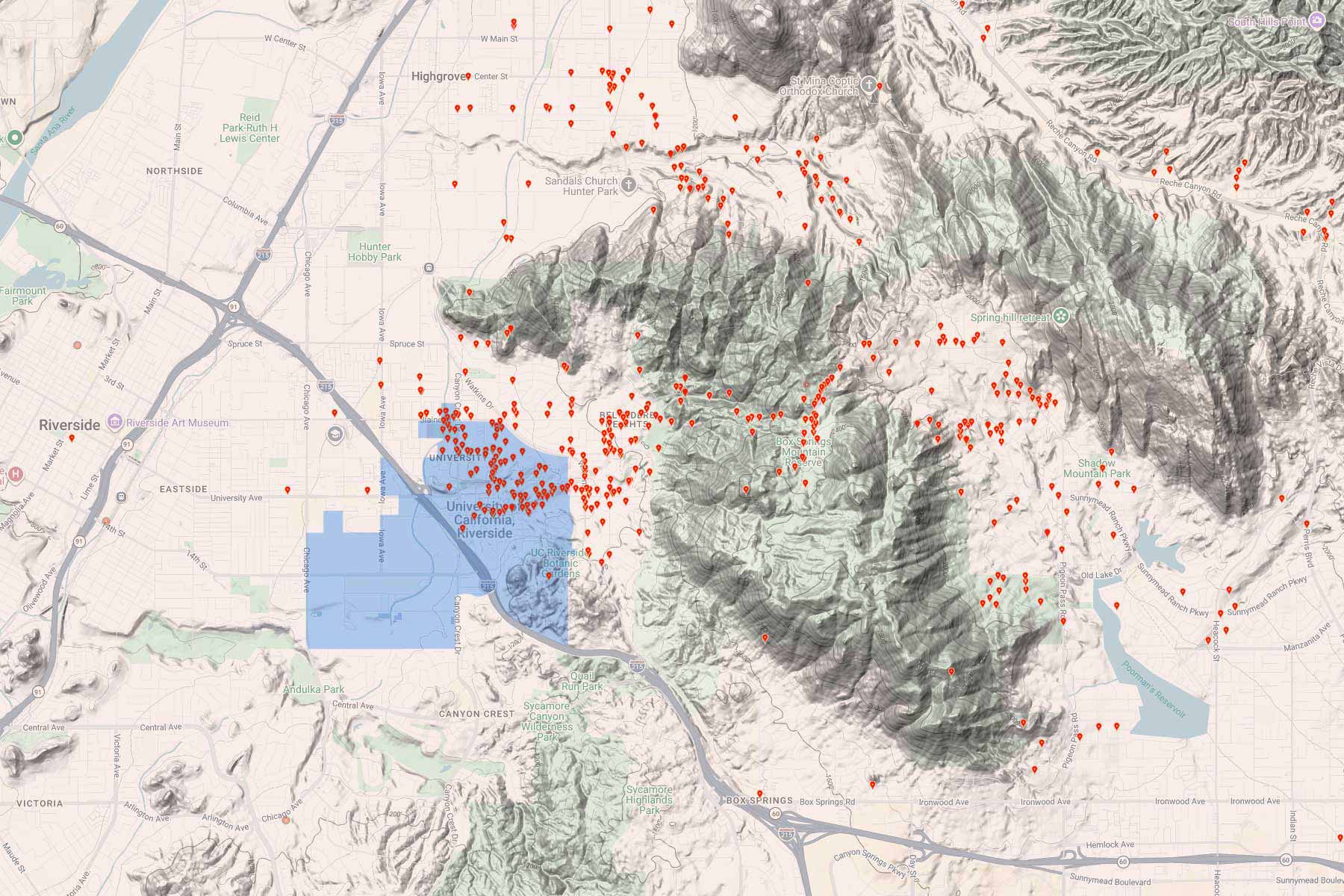
Recorded sightings of burros in the area around UCR and the Box Springs Mountain Reserve. (iNaturalist)
A later phase of the project would place GPS collars on selected burros to reveal how far they travel; how they use neighborhoods, parks, and open space; and where they cross roads. Because the animals are protected under the federal Wild Free-Roaming Horses and Burros Act, obtaining permission to capture and collar them will require additional coordination with wildlife agencies.
For Spasojevic, the project is about much more than counting burros. He suspects the animals play a more complicated ecological role than many people assume. In some areas, they appear to graze heavily on invasive annual grasses, potentially benefiting native plants. At the same time, their hooves create dense networks of trails that could increase soil erosion if populations become too large.
“We don’t really have a good gauge of their impacts,” Spasojevic said.
Learn how Spasojevich and his team are using hidden cameras to monitor the diverse wildlife found in Riverside County and how animal populations are being impacted by human development.
As development continues across western Riverside County, people increasingly share the landscape with wildlife. Better science, he said, will help officials make informed management decisions before burro populations become too large.
The findings could also help improve coexistence between residents and the burros by identifying safer road crossings and supporting public education to reduce vehicle collisions and unsafe interactions.
Finding Common Ground
Finding Common Ground
The overlap of suburban sprawl into wild spaces has put the burros at the center of a rising controversy.
To some residents, they are beloved reminders of the region’s rural heritage and mining past. To others, they are destructive, invasive animals responsible for property damage and growing public safety concerns. In recent years, they have been attacked by dogs, shot with arrows, struck by trains, and involved in numerous traffic collisions — the consequences of which have sometimes been tragic.
In October 2005, a 21-year-old Rialto woman was killed when the Honda Civic she was a passenger in struck a burro crossing Reche Canyon Road, a busy, windy route with a 50-mph speed limit connecting Moreno Valley and Colton. Although warning signs line the road, collisions involving burros have remained common.
In response to mounting safety concerns, the California Legislature in 2023 authorized counties to contract with nonprofit organizations to rescue, treat, and relocate undomesticated burros found on roadways or private property. San Bernardino County acted on that authority in late 2024 by hiring the Texas-based Peaceful Valley Donkey Rescue to remove burros from Reche and San Timoteo canyons. Over three weeks, the organization captured and relocated 256 burros to sanctuaries and adoption programs in Texas.
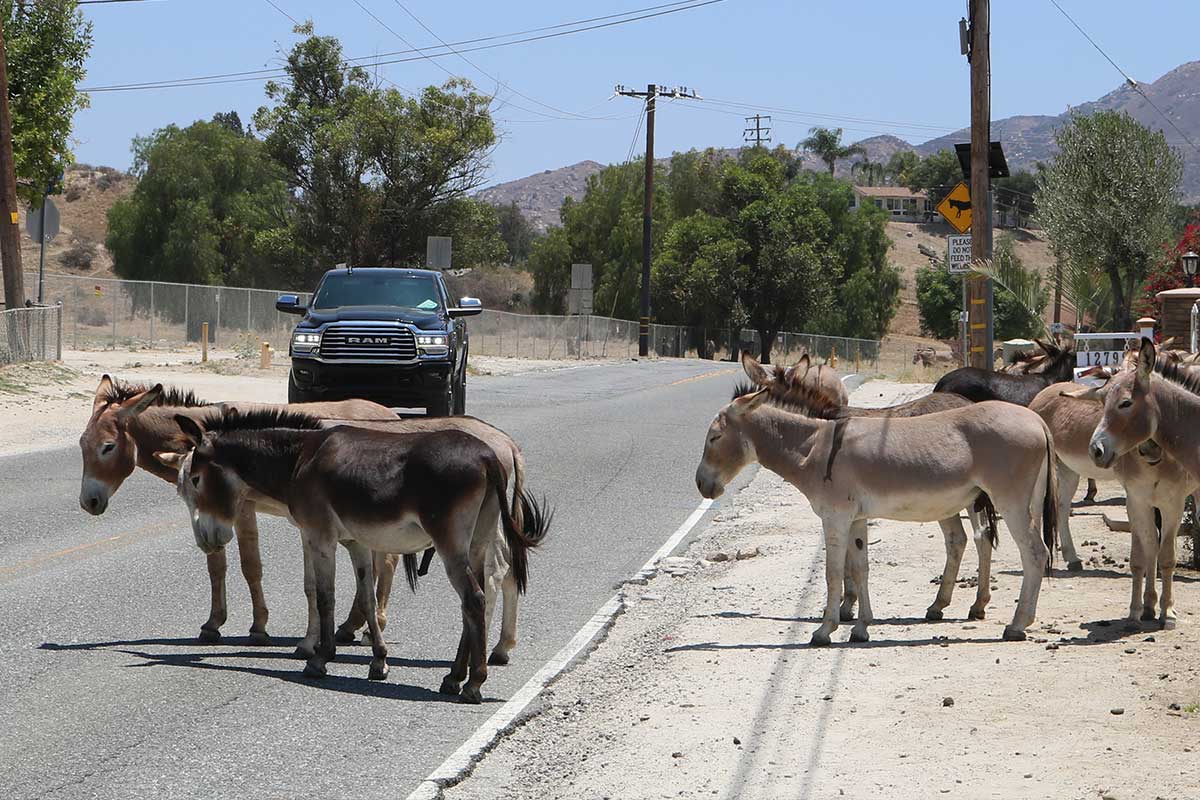
Wild burros crossing the winding road through Reche Canyon. (David Danelski)
The effort, however, sparked an emotional backlash. More than 13,000 people signed a petition opposing the removals, while social media posts accused officials of clearing the canyons for development and sending burros to slaughter — claims the county repeatedly denied.
County officials eventually ended the Peaceful Valley contract and instead partnered with the locally based DonkeyLand sanctuary to remove only sick, injured, or dangerous burros while also launching a fertility-control program.
For Jennifer Britton, an environmental humanities researcher at Drexel University in Philadelphia, the debate illustrates why better understanding the animals is so important.
After observing the burros in Riverside County in 2019 and again in 2022, she came away inspired by how the burros and humans have co-created a complex, entangled community. A study she co-authored found communities that foster coexistence with the animals create safer, more harmonious shared spaces.
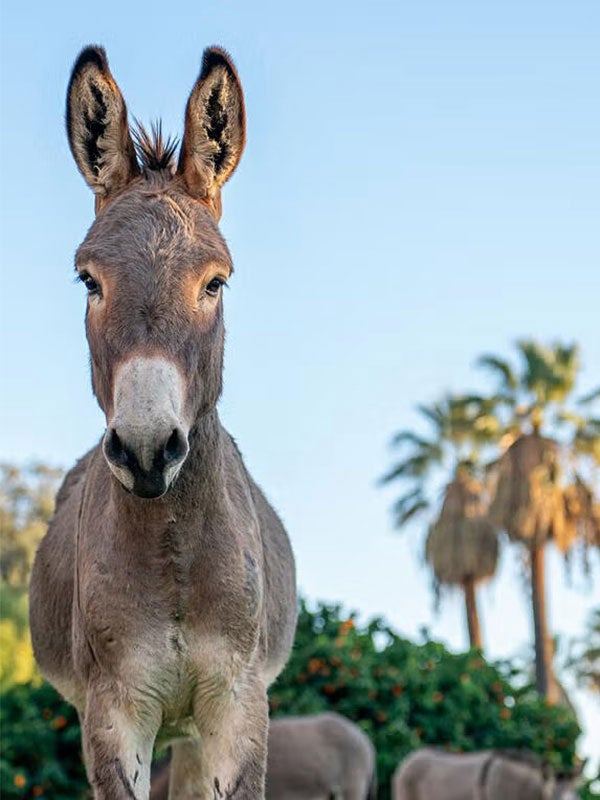
Wild burros have become a common sight around the UCR campus in recent years.
Britton agrees that no landscape has unlimited carrying capacity and that some population management may eventually be necessary. But, she said, managers should avoid large-scale roundups that separate family groups and remove animals from places where they have lived for generations.
“They’re individuals,” Britton said. “They have family bands, preferred places to graze, places they travel together, and different personalities.”
She hopes Inland communities find more humane ways to coexist with the burros, such as by reducing speed limits, establishing safer roadway crossing points, and allowing them the space they need to thrive.
As for the burros that frequent UCR, university officials have urged students, faculty, and staff to give them plenty of space and to never feed or approach them. So far, no major problems have been associated with their visits, and they have become an iconic presence on campus in recent years.
Spasojevic also sees the burros as providing students and faculty with a unique living laboratory.
“The donkeys provide a great opportunity to study the wildland-urban interface and to better understand how we can coexist with wildlife,” Spasojevic said. “We are hoping our initial research will catalyze other research and learning opportunities.” 
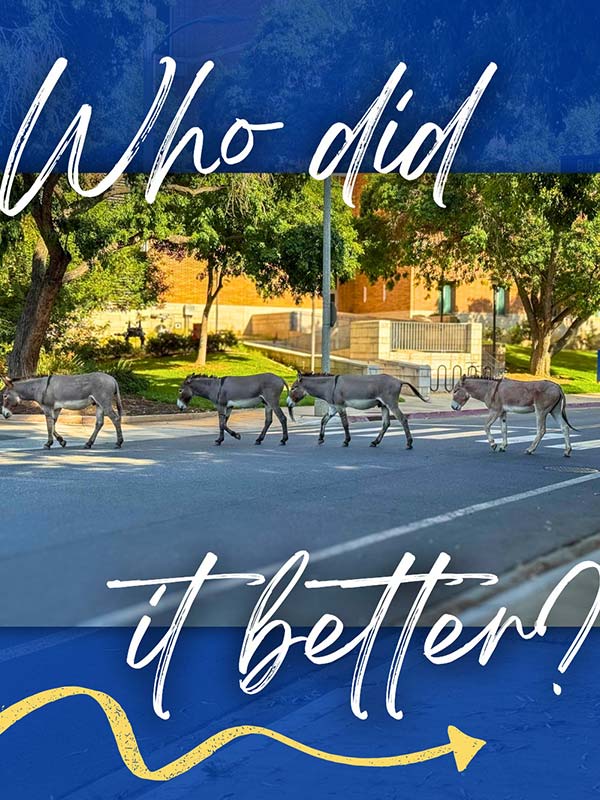
Donkey Do’s and Don’ts
They may be cute, but it is important to remember that the burros found around UCR and surrounding areas are wild animals and a federally protected species. Riverside County Ordinance No. 934 also makes interactions with untamed donkeys unlawful, with fines ranging from $100 to $500 for violations. Here are some do’s and don’ts if you encounter wild burros on or off campus.
- DON’T approach or touch them. They can be territorial and protective of their offspring, so make sure to enjoy them from a safe distance. A kick from a burro can be fatal.
- DO slow down when driving. If you see them on the road, be careful to avoid them. Collisions can be deadly for both burros and motorists alike.
- DON’T feed them. Doing so could reduce their natural instinct to forage and make them less fearful of people.
- DO report injured animals. If you see a burro that is injured or in distress, call the Riverside County Department of Animal Services at (951) 358-7387.